Mason Valley NV – August 26, 2026
September brings a change to the skies over Mason Valley. The evenings arrive noticeably earlier, summer begins giving way to autumn, and familiar summer stars slowly start their journey toward the western horizon. Yet September is hardly a quiet month overhead. Venus reaches its brightest, Mars puts on several interesting morning displays, the Harvest Moon rises near the end of the month, and two lesser-known meteor showers—the Aurigids and the September epsilon Perseids—give patient observers a reason to keep watching the dark sky.
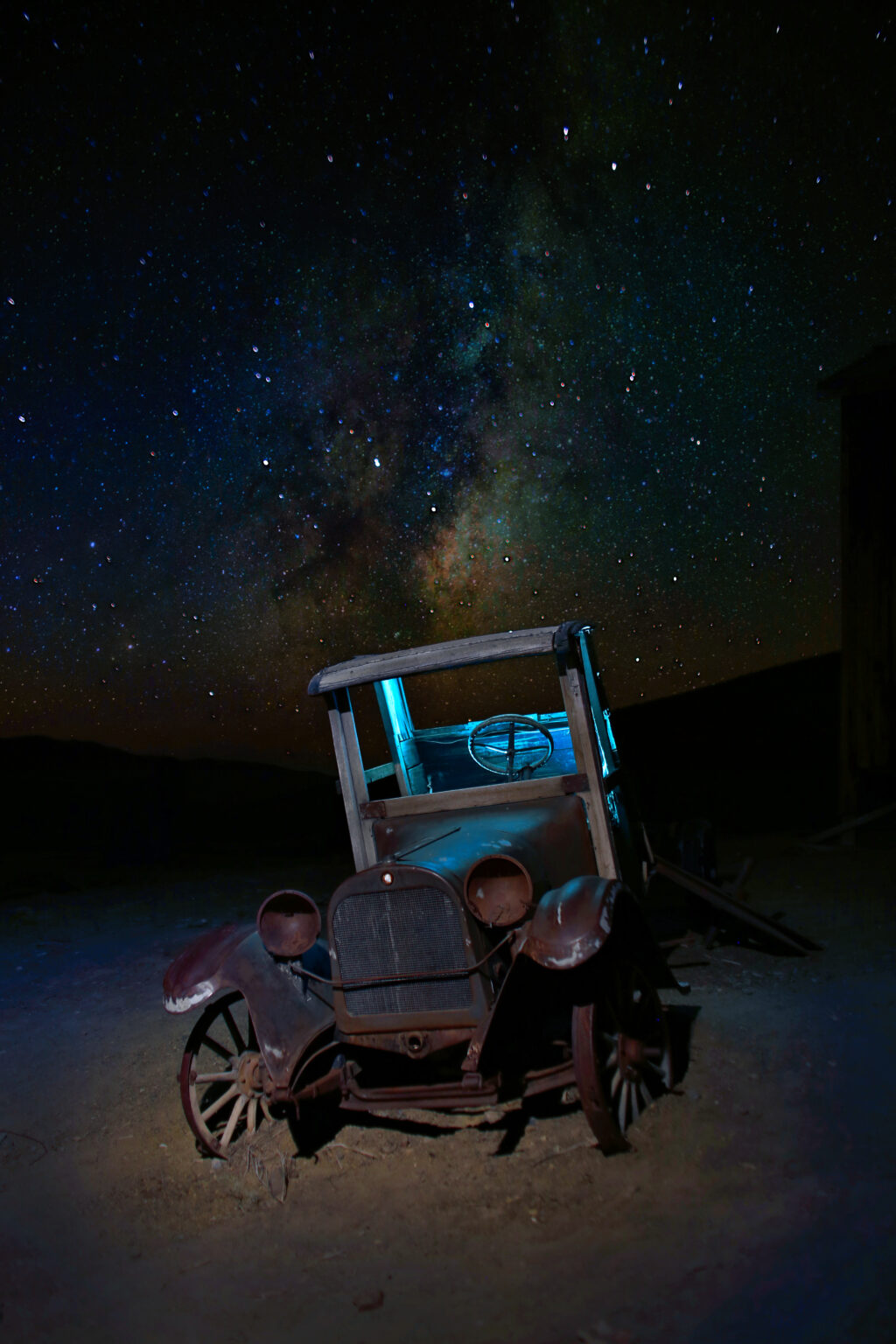
For those who have spent the summer learning to recognize the Milky Way, September offers another excellent opportunity. Early in the month, look for the familiar Summer Triangle—Vega, Deneb, and Altair—high in the evening sky. From a sufficiently dark location away from Yerington’s lights, the Milky Way appears as a faint, uneven, cloudy band running through this region of the heavens. It is still readily visible to the naked eye under a genuinely dark sky, although it gradually shifts farther west as autumn progresses.1
September opens with one of its lesser-known meteor showers already underway. The Aurigids are active from about August 29 through September 2, reaching their peak around September 1. The American Meteor Society gives the shower a typical zenithal hourly rate of about six meteors per hour under ideal conditions. The meteors appear to radiate from the constellation Auriga, which rises into a favorable position during the late-night and predawn hours.2
The Aurigids are not a shower that will fill the sky, and that is part of their charm. You may sit for some time without seeing one, then suddenly catch a fast meteor flashing overhead. They are best approached without expectations: find a dark place, look generally upward before dawn, and enjoy whatever the sky decides to provide.
A second minor shower follows close behind. The September epsilon Perseids are active from approximately September 2 through September 23, with their peak around September 9. Despite their name, these are not the same shower as the famous August Perseids, which come from Comet Swift-Tuttle and end in late August. The September epsilon Perseids are a separate meteor stream with a radiant in Perseus and a typical peak rate of about five meteors per hour under ideal dark skies.2
The timing is especially favorable this year because September’s New Moon occurs on September 10 at 8:26 p.m. Pacific time. That means the September epsilon Perseids peak almost exactly when moonlight is at a minimum, giving observers around Yerington unusually dark skies for trying to catch these faint meteors.3
The Moon continues its monthly rhythm with the Third Quarter on September 4, First Quarter on September 18, and the Full Moon on September 26. Those nights around September 8 through 11 should be particularly good not only for the September epsilon Perseids but also for seeing the Milky Way and other faint objects.3
One of September’s first attractive planetary sights comes before sunrise on September 6 and 7. The thin waning crescent Moon passes near reddish Mars and the bright twin stars Castor and Pollux in Gemini. On September 6 the Moon lies above Mars; by the following morning it has moved below it, creating a changing little arrangement that makes the Moon’s nightly motion against the stars easy to see.4
But September’s brightest attraction is unquestionably Venus.
Venus has been shining in the western evening sky throughout summer, but on September 18 it reaches its greatest brilliance for this evening appearance, shining at approximately magnitude –4.4. Only the Sun and Moon normally outshine Venus in our sky. Look west shortly after sunset. No telescope is necessary. Venus will be so conspicuous that it may be visible while the sky is still bright with twilight.5
There is an added attraction on the evenings of September 14 and 15, when the young crescent Moon appears near brilliant Venus. This should make an especially attractive naked-eye pairing low in the western evening sky.5
September also brings an event that we cannot actually see happen by looking into the night sky but can certainly notice here on Earth. The autumnal equinox occurs September 22 at 5:06 p.m. Pacific Daylight Time. At that moment the Sun crosses the celestial equator heading southward, formally beginning astronomical autumn in the Northern Hemisphere. Day and night are often said to be equal at the equinox, although because of atmospheric refraction and the way sunrise and sunset are defined, they are not precisely twelve hours each.6
There is another interesting planetary arrangement near the end of the month. Before sunrise around September 25, look east for Mars. Mars forms an almost straight line with Castor and Pollux, temporarily making the famous Gemini twins look rather like triplets. Below them, much brighter Jupiter will be appearing closer to the eastern horizon.4
Then comes the Full Moon on September 26. The full Moon nearest the September equinox traditionally carries the name Harvest Moon. The name comes from the unusual pattern of moonrise around this time of year: for several evenings near the Harvest Moon, the Moon rises relatively soon after sunset, historically providing farmers with additional evening light during the harvest season.7
There is something particularly fitting about ending September with the Harvest Moon. During the month we can still look upward and see much of summer—the Milky Way, Vega, Deneb, and Altair—but autumn is unmistakably arriving. Nights grow longer, sunrise comes later, and the constellations of another season begin waiting in the east.
For Yerington skywatchers, September offers a little of everything: the Aurigids at the beginning of the month, the September epsilon Perseids under nearly moonless skies, Mars and the crescent Moon before dawn, brilliant Venus after sunset, the Milky Way on dark nights, the turning of the seasons at the equinox, and finally the Harvest Moon rising over Mason Valley.
Perhaps September’s lesson is simply that the sky never really ends one season and begins another. It changes gradually, one evening at a time. All we have to do to notice is step outside—and look up.
Footnotes
- EarthSky, “Summer Triangle: Star pattern of the season,” explaining how Vega, Deneb and Altair form the Summer Triangle and how the Milky Way passes through this region under dark skies:
https://earthsky.org/favorite-star-patterns/summer-triangle-asterism-vega-deneb-altair/ - American Meteor Society, “2026 Meteor Shower List,” listing the Aurigids as active August 29–September 2 with a September 1 peak and typical ZHR of 6, and the September epsilon Perseids as active September 2–23 with a September 9 peak and typical ZHR of 5:
https://www.amsmeteors.org/meteor-showers/2020-meteor-shower-list/ - Time and Date, “Moonrise, Moonset, and Moon Phase in Yerington, September 2026,” giving the September 2026 lunar phases for Yerington, including Third Quarter on September 4, New Moon on September 10, First Quarter on September 18, and Full Moon on September 26:
https://www.timeanddate.com/moon/@5515507?month=9 - EarthSky, “Best Stargazing of 2026: Top Events Not to Miss,” describing the Moon and Mars on September 6–7 and the September 25 alignment of Mars with Castor and Pollux, with Jupiter below:
https://earthsky.org/tonight/best-stargazing-of-2026-astronomy-top-events-calendar/ - EarthSky, “Venus Brightest in the Evening Sky This Week,” stating that Venus reaches its greatest evening brilliance on September 18, 2026, at about magnitude –4.4 and noting the crescent Moon near Venus on September 14 and 15:
https://earthsky.org/astronomy-essentials/venus-brightest-greatest-brilliancy-greatest-illuminated-extent-2/ - EarthSky, “2026 September Equinox: All You Need to Know,” giving the September equinox at 00:06 UTC on September 23, 2026, equivalent to 5:06 p.m. Pacific Daylight Time on September 22 in Nevada:
https://earthsky.org/astronomy-essentials/everything-you-need-to-know-september-equinox/ - The Old Farmer’s Almanac, “What Is the Harvest Moon?” explaining the traditional name and the unusually short interval between successive moonrises around the Harvest Moon:
https://www.almanac.com/content/what-harvest-moon





More Stories
BATTLE BORN MEDEVAC SPEAKS TO YERINGTON ROTARY ON CRITICAL AIR SERVICES
ROTARY CLUB OF YERINGTON CONTINUES NEARLY 20-YEAR TRADITION OF GIVING DICTIONARIES TO LOCAL 3RD GRADE STUDENTS
Yerington City Council Reviews Housing Master Plan and Approves Phase II of Harvest RV Resort