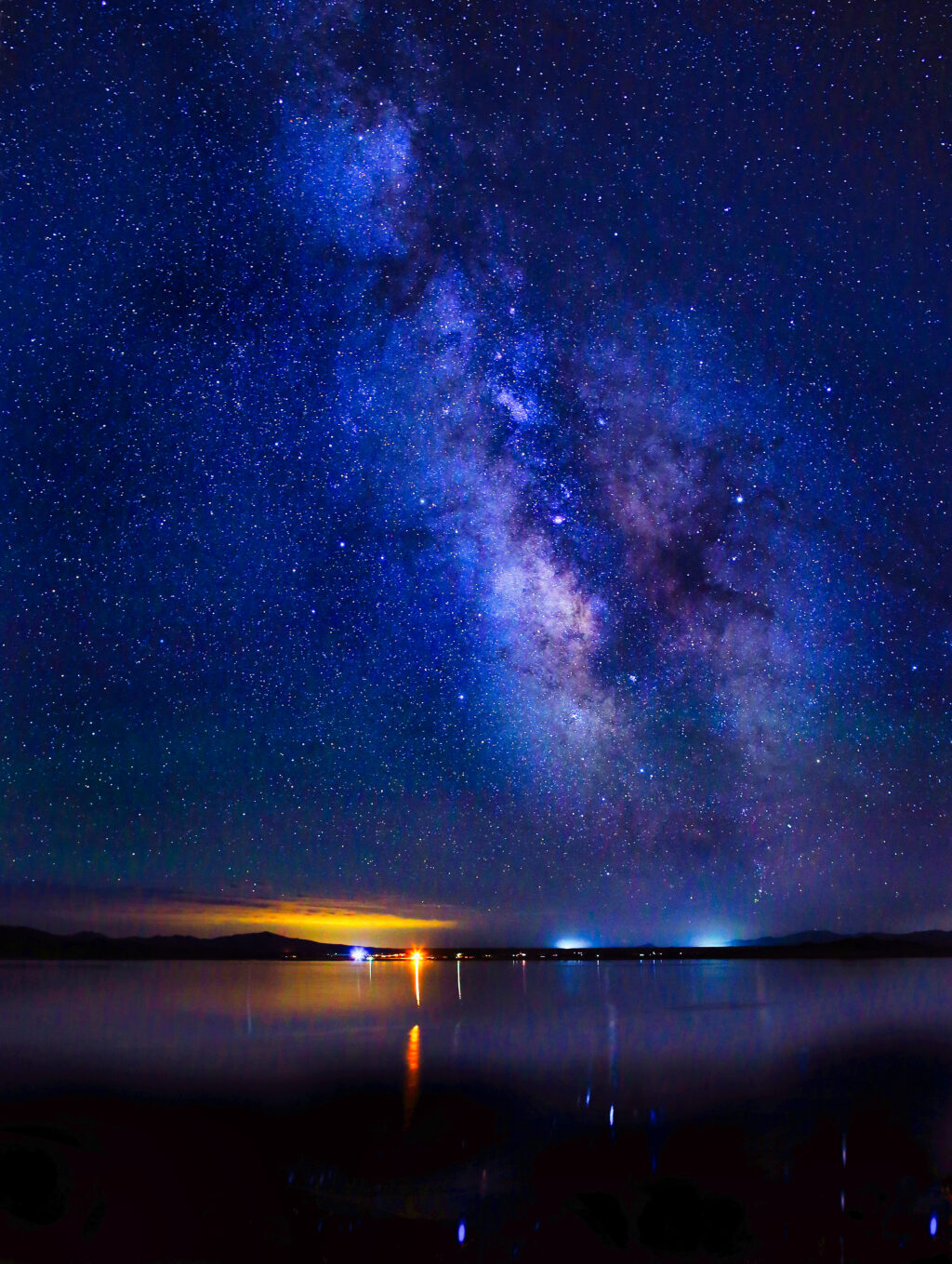
Mason Valley NV – May 26, 2026
As June settles over Mason Valley, the days grow long and warm, but the night sky still offers gentle rewards for anyone willing to stay up a little later. This is one of the finest times of year to begin seeing the Milky Way with the naked eye from darker areas around Yerington. In the Northern Hemisphere, May and June provide some of the greatest hours of Milky Way visibility, and under dark, moonless skies the galaxy appears not as a sharp stripe, but as a broad, faint, silvery band of distant starlight.1
June also brings the turning point of the year. The summer solstice arrives early on June 21, 2026, marking the longest day of the year in our region. The solstice occurs at 1:24 a.m. PDT for Yerington2
For moon watchers, June offers a helpful rhythm. In Yerington, the Last Quarter Moon falls on June 8 at 2:56 a.m., the New Moon on June 15 at 1:38 p.m., the First Quarter Moon on June 20 at 6:09 p.m., and the Full Moon on June 29 at 4:55 a.m. Those darkest nights around mid-month will be the best time to look for the Milky Way, because moonlight will not wash out the fainter stars.3
One of the month’s most attractive sky events comes early. On the evenings of June 8 and 9, Venus and Jupiter appear in a striking conjunction after sunset, drawing very close together in the western sky. EarthSky reports that the two planets will be separated by only about 1.5 degrees, making them one of June’s easiest and prettiest naked-eye sights.4
June’s meteor activity is quieter than some other months, but not absent. The Arietids, often described as the year’s most active daytime meteor shower, are predicted to peak around the morning of June 10, 2026. Because their radiant lies close to the Sun, they are not easy to observe, but a few meteors may sometimes be caught in the dark hour before dawn.5
For local observers, the best advice is simple: choose a moonless night in the middle part of June, drive a little way from the brightest town lighting, and let your eyes adjust for at least fifteen or twenty minutes. Avoid checking a phone screen. Then look for the Milky Way as a pale, cloudy sweep across the sky rather than a brilliant white line. In Nevada’s open country, that soft band of light can still be one of the most beautiful sights of summer.1
June skies over Yerington do not shout. They invite. They offer the bright pairing of planets, the long arc into summer, the dark nights around the New Moon, and the ancient, quiet presence of our own galaxy overhead. For those who step outside and look up, June remains one of the most generous months of the year.1
Footnotes
- EarthSky, “Best Milky Way Pics of 2021,” noting that May and June provide the maximum hours of visibility of the Milky Way and discussing naked-eye viewing under dark skies:
https://earthsky.org/todays-image/best-milky-way-pics-of-2021/ - Time and Date, “Sunrise and sunset times in Reno, June 2026,” giving the June solstice for Reno at 1:24 a.m. on June 21, 2026:
https://www.timeanddate.com/sun/usa/reno?month=6 - Time and Date, “Moon Phases for Yerington, Nevada, June 2026,” listing the principal moon phases and times for Yerington:
https://www.timeanddate.com/moon/phases/@5515507 - EarthSky, “Venus-Jupiter conjunction in June: Start watching now!” stating that the conjunction falls around June 8 and 9, 2026, with a separation of about 1.5 degrees:
https://earthsky.org/tonight/venus-jupiter-conjunction-june-2026-charts-how-to-see/ - EarthSky, “Arietids – most active daytime meteor shower – EarthSky,” noting that in 2026 the Arietids are predicted to peak around the mornings of June 10 and may be caught in the dark hour before dawn:
https://earthsky.org/astronomy-essentials/arietids-daytime-meteor-shower-peaks/




More Stories
Sheriff Pope’s Message of the Week on October 9, 2026
Lyon County eyes ZIP code cleanup after backing Storey County
Four Candidates. Two Offices: Lyon County Sheriff and DA Candidates Make Their Case