
Fernley NV – October 8, 2026
By Suzanne Prouty
The Because I Can Foundation brought candidates for sheriff and district attorney together Oct. 5 at Fernley City Hall to help residents understand the candidates’ experience, priorities and approaches to leadership. The two-and-a-half-hour forum gave Lyon County voters a chance to consider who should enforce the law and who should prosecute those accused of breaking it.
Host and organizer Teresa M. Morros opened by noting that the two offices serve different roles but both have a tremendous impact on public safety, accountability and the justice system in Lyon County. The evening, she said, was about giving voters information to make their own informed choices.
Kim Barney also moderated and organized the event, while panelists Greg Evangelatos and Sarah Braswell posed questions. Kim Swanson kept time and ran the Zoom broadcast.
SHERIFF
Incumbent Sheriff Brad Pope, who joined the Lyon County Sheriff’s Office in 2005 and took office as sheriff in January 2023, pointed to six commitments he made during his 2022 campaign. They included promises to lower crime, reduce response times and increase transparency.
“I’m proud to say that we’ve accomplished every one of those goals,” he said.
Pope said the county’s 911 response time was about 30 minutes in 2022 and has since dropped to about seven minutes. He said he understands the department’s $24 million budget, citing his business degree in management and administration. He said Fernley now has 19 deputies assigned, with 18 actively working, up from about half that number in 2022.
On school safety, Pope said crimes in schools were going unreported when he first took office. He and his chief deputy met with Superintendent Logan and created a zero-tolerance policy.
“The school is not a sanctuary for a crime to be committed,” he said.
He also highlighted grant-funded mental health counseling in the jail, a new inmate tablet system and efforts to keep a reentry position funded to reduce recidivism.
Pope said a limited school district grant covers about 2.5 school resource officer positions, while the sheriff’s office now provides five officers plus a K-9. The goal, he said, is to break down barriers between law enforcement and children so students know they can come to a deputy for help.
Pope emphasized enforcement as central to his approach to public safety.
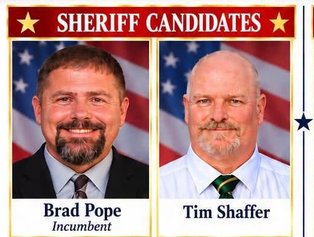
Challenger Tim Shaffer, who has nearly 30 years in law enforcement, said his experience has been entirely as a deputy — reserve, jail, patrol and, most recently, behavioral health peace officer.
“I’ve been on the front line for my entire career,” he said. “I believe I can do a better job and hopefully bring back ethics and accountability to the sheriff’s office.”
Shaffer said his priorities include expanding mental health response, citing what he called a crisis in Nevada and nationwide. He also wants better deputy training, from the field training program through POST, going beyond state minimums and possibly using grants so deputies can train elsewhere.
On budgets, he said he met with county Comptroller Josh Foley to learn how the department budget works.
“I believe I have enough experience to be able to supervise and do what I think needs to be done,” he said.
On the jail counseling program, Shaffer called it “a really, really good program” that should continue and grow. He emphasized defusing mental health situations the department often faces both at the jail and in the community before they lead to arrests.
DISTRICT ATTORNEY
Mark Krueger, who has practiced law in Northern Nevada for 25 years, including six as Lyon County’s chief deputy district attorney, said he has prosecuted more than 40 criminal jury trials, from drug cases to elder abuse.
He cited one case that ended in a sentence of 375 years to life, which he called the longest in Lyon County history.
“I did not do that for headlines. I did that for justice for six little girls,” he said.
He said Sheriff Pope endorsed him because “he knows that I have the experience to do the job on day one.”
Krueger, now a chief deputy attorney general in the Bureau of Consumer Protection, said he has handled the state’s opioid litigation, which he said brought in more than $1 billion, and has held social media companies such as Meta accountable for harms to children.
If elected, he said he wants to build a larger victim-witness program to help victims navigate the court system.
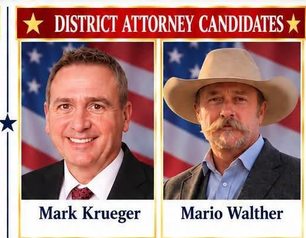
Mario Walther, who was born and raised in Lyon County, said he has spent his entire legal career in Lyon County, appearing in county courtrooms almost daily.
“Lyon County is home,” he said, adding that he is the only candidate in the race who lives in the county and is raising a family there.
His practice spans civil and criminal litigation, estate planning, and agricultural and water law, and he cited support from local employers, small businesses, farmers and ranchers.
Walther said he is honored to be endorsed by the Lyon County Employees Association, as well as PSAN (Public Safety Alliance of Nevada) and NAPSO (Nevada Association of Public Safety Officers), which he said represent most law enforcement employees in the state.
“As your district attorney, this is personal to me,” he said, describing his motivation as protecting his own children and Lyon County.
Walther said his focus would be on ensuring full staffing levels to cover cases, which he said would improve morale and help retain attorneys in the department. He also emphasized the importance of strong communication between the district attorney and sheriff.
In response to a question about handling cases with insufficient evidence, Krueger said he would meet with victims and their families and would not proceed without the necessary evidence.
Walther emphasized communicating clearly about such decisions. He also stressed the need for strong evidence because, as a mentor once told him, “You can’t make chicken soup out of chicken poop.”
Asked how they would balance collaboration with law enforcement against independent prosecutorial discretion, Walther said he works with Lyon County Sheriff’s Office deputies daily and that they have seen his abilities in the courtroom. Working with the sheriff’s office, he said, is one of his top priorities.
Krueger answered that he is “the only candidate in this room who’s actually done it.”
The district attorney’s office serves as a check and balance on the sheriff’s office, he said, but the two must work together through communication, guiding investigators without directing them.
“There are gonna be times that we can’t prosecute,” he said, “but we can collaborate, work together, and end up with the result that’s fair and just.”
In rebuttal, Walther said he had never suggested the two offices should have an adversarial relationship. He reiterated the importance of relationships, especially with the sheriff, when discussing accountability.
Victim services drew attention from both candidates. Krueger advocated for a victim-witness program; Walther discussed working with nonprofit agencies to provide support. Both emphasized early communication and keeping victims informed.
Questions about wrongful prosecution brought calls for reviewing evidence and correcting mistakes. Walther supported independent review and consideration of new evidence. Krueger said errors should be corrected.
Both also addressed the practical work of running the office. Krueger emphasized training, recognizing employees’ contributions and managing cases efficiently. Walther stressed maintaining a fully staffed office and retaining employees.
In conclusion, Walther said one measure voters could use to evaluate the district attorney’s office would be the number of convictions in major drug cases. Krueger emphasized transparency and publishing data for the community.
The final round asked all four candidates to state three measurable results the public would see if they were elected.
Walther said voters should expect a fully staffed district attorney’s office that continues to grow, employees who stay and improved relationships.
Krueger cited teamwork within the department and with the sheriff, a victim-witness advocate and transparency.
Pope said voters should expect quick and safe response times, a focus on criminal activity and transparency.
Shaffer cited improved mental health services, better training for deputies and strong communication between the district attorney and sheriff.
The forum’s purpose was to give residents information to make their own choices. Across both races, the answers offered voters a basis for weighing experience, priorities and judgment — and considering what accountability should look like after the election.
The general election will be held Tuesday, November 3.
In Lyon County NV, early voting begins on October 17 at Fernley City Hall (595 Silver Lace Boulevard0; Yerington Admin. Complex (27 S. Main St.0; Dayton Utilities Building (34 Lakes Boulevard), Silver Springs Hillyard Hall Community Center (2945 Ft. Churchill St.); and on October 26 at the Tribal Administrative Complex at 171 Campbell Lane in Yerington.
Thank you to Journalist Suzanne Prouty and The Great Basin Sun’s Fernley Reporter for sharing this article! -Pizen Switch Times


More Stories
Lyon County eyes ZIP code cleanup after backing Storey County
Lyon County moves to allow multifamily housing on commercial land
Lyon Planning Commission Agenda, Zoom Link and Documents for Tuesday, October 13, 2026