By Richard Massey
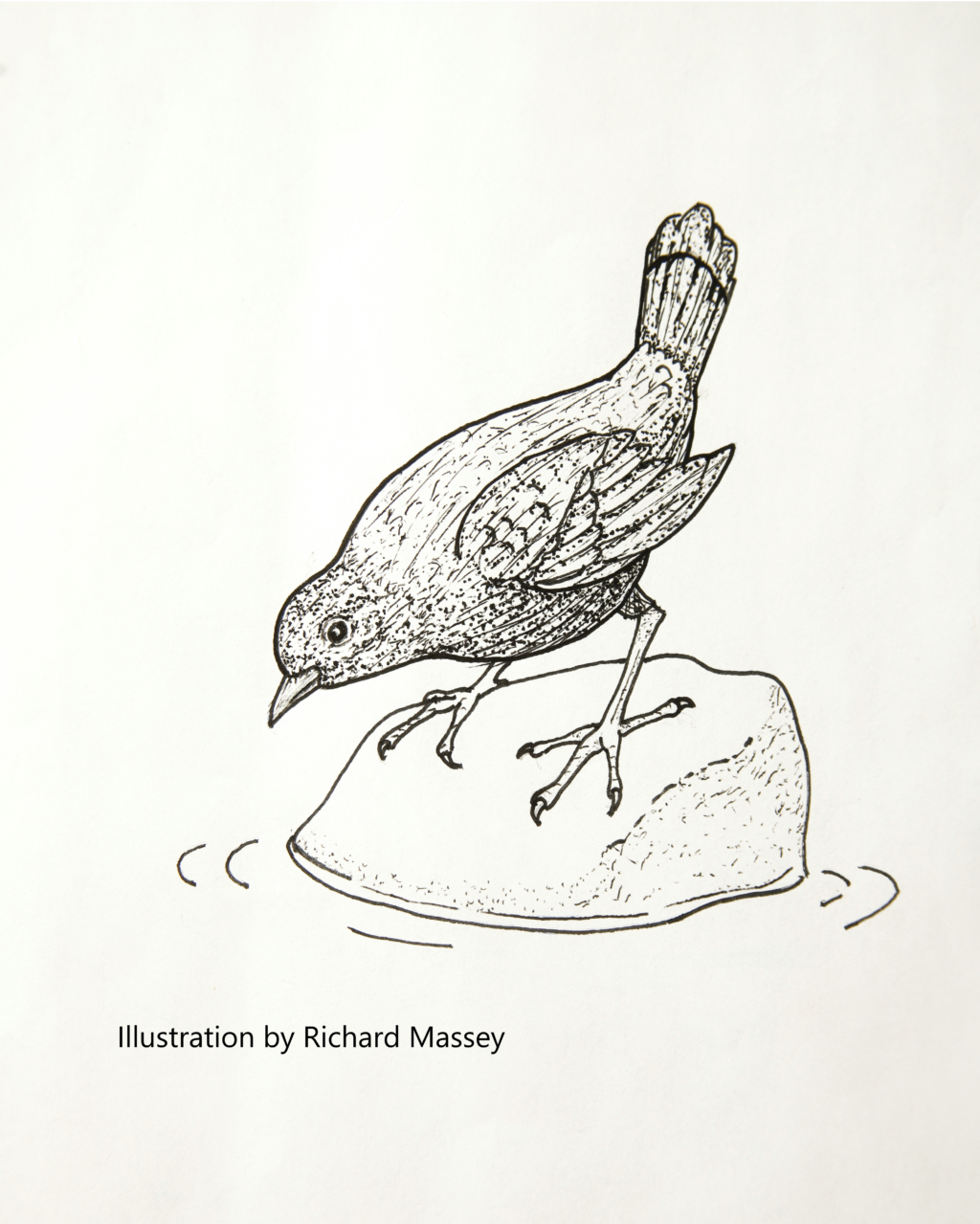
Several years ago, when I was a camp host at McArther-Burney Falls Memorial State Park, I was asked to contribute stories for their guide book. My short story about one of my favorite birds, the American Dipper, was quite popular. I was never able to get a good photograph of one so I drew a picture of it!
From the bank of a flowing Sierra stream, I watched a small, soot-colored bird nervously hop from one damp, moss-covered rock to another. After each landing he would stop and without leaving the ground bob up and down a dozen times. The bouncing was so rapid that I thought the poor thing had a serious physical disorder. But, I haven’t seen anything yet.
Before I knew it, he had hopped down to the water’s edge, and without hesitation stuck his head underwater. At times his body was half way under. His head was rocking back and forth in the current. It appeared he was watching something. How those bony little feet kept him from being swept away was something I couldn’t understand.
Now, I am convinced his condition is far more serious than I originally thought. Not only did he have a serious physical condition, it was obvious he was now trying to commit suicide by drowning! After several seconds he popped up, moved upstream a few feet and stuck his head under again. This time I was counting; ten, eleven, twelve, thirteen, fourteen, fifteen, sixteen seconds, and up he came. But, I haven’t seen anything yet.
As soon as his head cleared the water, he looked around for a second before doing another quick set of twelve excited push-ups. Next thing I knew, he dove head first into the flowing current. The stream was about three feet deep, crystal clear, and moving fast. If I hadn’t seen it with my own eyes, I wouldn’t have believed what I was seeing. There he was clear as could be, walking along the bottom. With his head down, he was moving upstream against the current. Occasionally he would stop and poke around the broken gravel. Then, suddenly he would dart off in another direction. No one is going to believe this story. But, I haven’t seen anything yet.
A few yards upstream there was a small pool about ten feet wide and four feet deep. Still walking along the bottom, he came to a drop-off leading into the pool. He dug his feet against the ledge and with a burst of energy, launched himself out across the deepest part. He was two feet off the bottom and two feet below the surface. He wasn’t walking; he was flying underwater! Would swimming be the correct term? He was flapping his wings and moving through the water at a pretty good clip. I know those scrawny, web-less feet weren’t helping.
With a few powerful flaps of his wings, he was across the pool. He exited the water by climbing and flapping up a vertical rock face. When he was about six feet above the water, he looked in my direction and launched himself into the air. He missed me by about six feet as he shot past like a little rocket heading off downstream. I was sure that chubby little body with those short wings and tail had to move fast to stay airborne.
This was my first introduction to Cinclus mexicanus. He also goes by the names Water Ouzel and American Dipper. Over the years I have spent countless hours being entertained by the antics of this amazing bird. I’m pleased to report that the Dipper is a common sight throughout Burney Falls State Park. You are likely to see him along the rocks, close to the water’s edge.
Interesting facts about dippers:
It got its name from the unusual habit of bobbing up and down.
Uses his wings to fly/swim underwater.
Can swim to a depth of twenty feet.
Can stay underwater for over twenty seconds.
It is not considered an aquatic bird and does not have webbed feet.
Favorite nesting site is a ledge behind a waterfall.
Its nest is a large dome shaped structure made of leaves, moss, and grass.
Doesn’t venture far from water.
Has a chunky body with short wings and tail.
Its body shape is similar to a wren but is 50% larger (5”-7.5”).
The color is usually a sooty gray with darker wings and tail.
Has a dark bill but flesh colored legs.
Sexes are similar in size and color.
Juveniles may be lighter in color with mottled chest and light colored bill.
Diet consists primarily of aquatic insects and their larvae.
The range is western Americas, from Alaska south to Argentina.
Editor’s note: This story was previously published in the “California State Parks Guide” and the “Intermountain News.” It appears here with their permission.

https://www.youtube.com/@richardmasseyphotography
Richard’s drawing of the American Dipper is spot-on to Kyle Dudgeon’s short video!




More Stories
Remembering Justin Joseph Beltran & Jena-Marie Ortiz
Sheriff Pope’s Message of the Week on February 27, 2026
Mari Basaca Fuentes to compete in Poetry Out Loud State Finals in Reno on March 7, 2026