Yerington NV – June 8, 2026
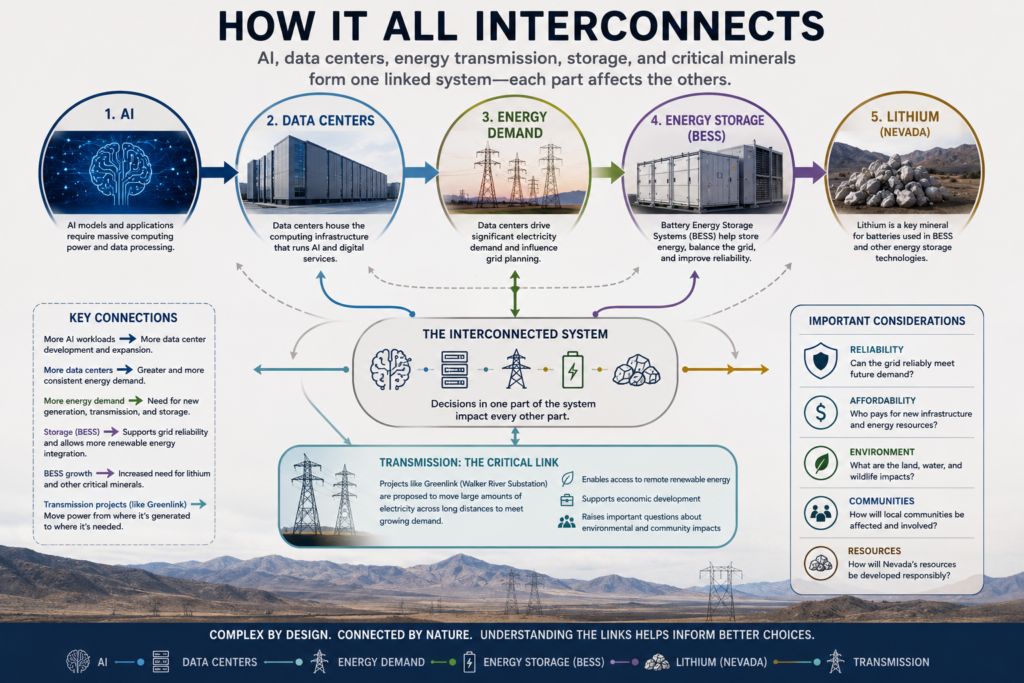
Data centers; cloud computing; AI Artificial Intelligence; chatbots; and energy creation, transmission & storage are all interconnected pieces of the modern technology ecosystem.
This is a thorough (albeit lengthy) explanation of how Mason Valley and Yerington, Nevada are directly effected by these modern issues.
Understanding Data Centers, Cloud Computing, AI, and Chatbots
The Digital Infrastructure Behind Everyday Technology
Every day, millions of people send emails, stream videos, shop online, use navigation apps, and interact with artificial intelligence. Most of us rarely think about what makes these digital services possible. Behind the scenes, a vast network of technology works together to store, process, and deliver information around the world.
This article explores the journey from data centers—the physical foundation of the internet—to the AI-powered chatbots that are becoming increasingly common in our daily lives.
What Is a Data Center?
A data center is a facility that houses computer systems and related equipment used to store, process, and distribute data. Think of it as a digital warehouse filled with powerful computers called servers.
These servers store websites, applications, databases, videos, emails, and countless other forms of digital information. Whenever you browse the internet, stream a movie, or access a cloud-based application, you are likely interacting with one or more data centers.
Data centers are carefully designed to operate continuously, often 24 hours a day, 365 days a year.
In late 2025, Copia Power took 1st step toward building the Monarch Data Center in Mason Valley, Nevada by acquiring a Lyon County Master Plan zoning change from Agricultural to Specific Plan for the Monarch Data Center, consisting of 4.6 million square feet of data centers over 14 separate buildings and to include battery energy storage systems, a potential natural gas backup system, an electrical substation, high voltage power lines and other accessory uses over two parcels totaling approximately 505 acres in Mason Valley, east of US Highway 95A and accessed by Penrose Lane
December 5, 2025 Master Plan Amendment for Monarch Data Center
The Lyon County Board of Commissioners approved, in a 4–1 vote (Commissioner Hockaday opposed), a request from Copia Power Devco, LLC for a Master Plan Amendment changing the land use designation from Agriculture to Specific Plan for the proposed Monarch Data Center in Mason Valley. The decision followed a presentation from Copia representatives and extensive public comment both for and against the proposal.
How Does a Data Center Work?
Inside a data center are thousands of servers connected by high-speed networks.
When a user requests information, such as opening a website, the following process occurs:
- The user’s device sends a request through the internet.
- Network equipment routes the request to the appropriate server.
- The server processes the request and retrieves the necessary data.
- The information is sent back to the user’s device, often within seconds or even milliseconds.
To ensure reliability, data centers include backup power systems, cooling equipment, security systems, and multiple internet connections. These support systems help keep services running even during power outages or hardware failures.
Are Data Centers Important?
Data centers have become critical infrastructure for modern society.
They support:
- Online banking and financial services
- Healthcare systems
- Government operations
- E-commerce and online shopping
- Social media platforms
- Video streaming services
- Artificial intelligence applications
Without data centers, many of the digital services people rely on every day would not function.
As businesses and consumers generate more data, the demand for data centers continues to grow.
What Is Cloud Computing?
Cloud computing refers to the delivery of computing services over the internet rather than from a local computer or server.
Instead of purchasing and maintaining their own hardware, businesses can rent computing resources from cloud providers. These resources may include data storage, software applications, processing power, and networking services.
A simple example is online file storage. Rather than saving documents only on a personal computer, users can store them in the cloud and access them from almost anywhere with an internet connection.
Cloud computing offers several advantages:
- Flexibility
- Scalability
- Cost savings
- Remote accessibility
- Faster deployment of services
The cloud itself is powered by large networks of data centers located around the world.
What Is Artificial Intelligence (AI)?
Artificial intelligence, commonly known as AI, is technology that enables computers to perform tasks that typically require human intelligence.
Examples include:
- Understanding language
- Recognizing images
- Translating text
- Making recommendations
- Solving problems
- Generating content
AI systems learn from large amounts of data and use complex mathematical models to identify patterns and make predictions.
As AI technology advances, it is being used in industries ranging from healthcare and education to finance and transportation.
What Is a Chatbot?
A chatbot is a software application designed to communicate with people through text or voice.
Some chatbots follow simple rules and provide predefined responses. More advanced chatbots use artificial intelligence to understand questions and generate natural-sounding answers.
Chatbots can help users:
- Find information
- Receive customer support
- Schedule appointments
- Troubleshoot problems
- Learn new topics
Because chatbots can interact with many users simultaneously, they have become valuable tools for businesses and organizations.
How AI Chatbots Use Data Centers and Cloud Infrastructure
AI chatbots depend on both cloud computing and data centers to operate effectively.
When a user sends a message to an AI chatbot, the request travels through the internet to servers located in a data center.
There, powerful computers process the request, analyze the language, generate a response, and send the answer back to the user.
The process happens so quickly that it often feels like a real-time conversation.
Modern AI systems require enormous computing resources. Many rely on specialized computer chips designed specifically for artificial intelligence workloads. These systems are typically housed within large-scale data centers and accessed through cloud platforms.
Without data centers and cloud infrastructure, today’s advanced AI chatbots would not be possible.
Future Trends: AI, Edge Computing, and Sustainable Data Centers
Technology continues to evolve rapidly, and several trends are shaping the future of digital infrastructure.
Artificial Intelligence Growth
AI applications are becoming more capable and more widely used. As demand increases, organizations are investing heavily in new computing facilities designed specifically for AI workloads.
Edge Computing
Edge computing brings processing power closer to where data is created.
Instead of sending all information to distant data centers, some processing occurs near the user or device. This approach can reduce delays and improve performance for applications such as autonomous vehicles, smart factories, and real-time analytics.
Sustainable Data Centers
As data centers consume significant amounts of electricity, companies are working to improve efficiency and reduce environmental impact.
Many new facilities are adopting:
- Renewable energy sources
- Advanced cooling technologies
- Energy-efficient hardware
- Water conservation strategies
Sustainability is becoming a major priority as the digital economy continues to expand.
NV Energy is currently building the Greenlink Nevada Project to create, transmit and supply energy for the increasing demands due to Data Centers, etc. A 500kV transmission line will reach the Walker River Power Substation in 2026.
Winston Solar Field is set to create a 780,000 panel solar field on 2374 acres in northern Mason Valley. Lux Solar Field plans construction in the same area. Libra Solar Field is currently being constructed south of Mason Valley on the Mineral & Lyon County line.
Conclusions
Residents of Mason Valley, Nevada utilize the services that data centers provide through AI storage. But there are concerns about the placement of data centers within our agricultural valley, near family farms and residences.
There are further concerns about the changing ‘face’ of Mason Valley with 780,000 solar panels from only 1 of the planned projects.
Add to these 2 concerns, the placement of the Pinenut BESS Battery Energy Storage System in the northern part of the valley along with a BESS planned for the Monarch Data Center.
Finally, by the end of 2026, Mason Valley residents may see the 130 to 180 foot metal H pole structures built to hold the 525kV transmission lines as they traverse through the valley.
NV Energy has created the Greenlink Nevada Project to expand Nevada’s energy grid and transport renewable energy across the state through two primary high-voltage 525kV transmission lines and supporting infrastructure – Greenlink West and Greenlink North.
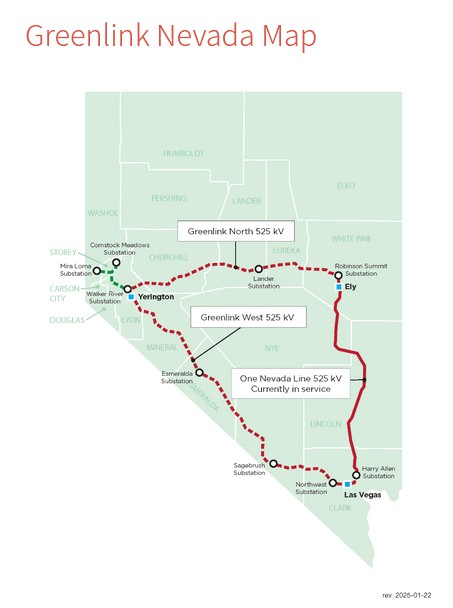
Greenlink West is currently being built, and the Walker River Substation in Mason Valley, Nevada is being completed next to the already-existing Fort Churchill Substation. Yerington/Mason Valley is one of the major hubs for Greenlink Nevada.
Where will all the new energy be generated from? A large amount will be from the vast solar fields that are currently under construction.
How will this solar-generated energy be stored? In extensive Battery Energy Storage Systems BESS made up of extensive lithium batteries.
Where will the lithium come from? Extensive lithium mining operations are gearing up in the State of Nevada.
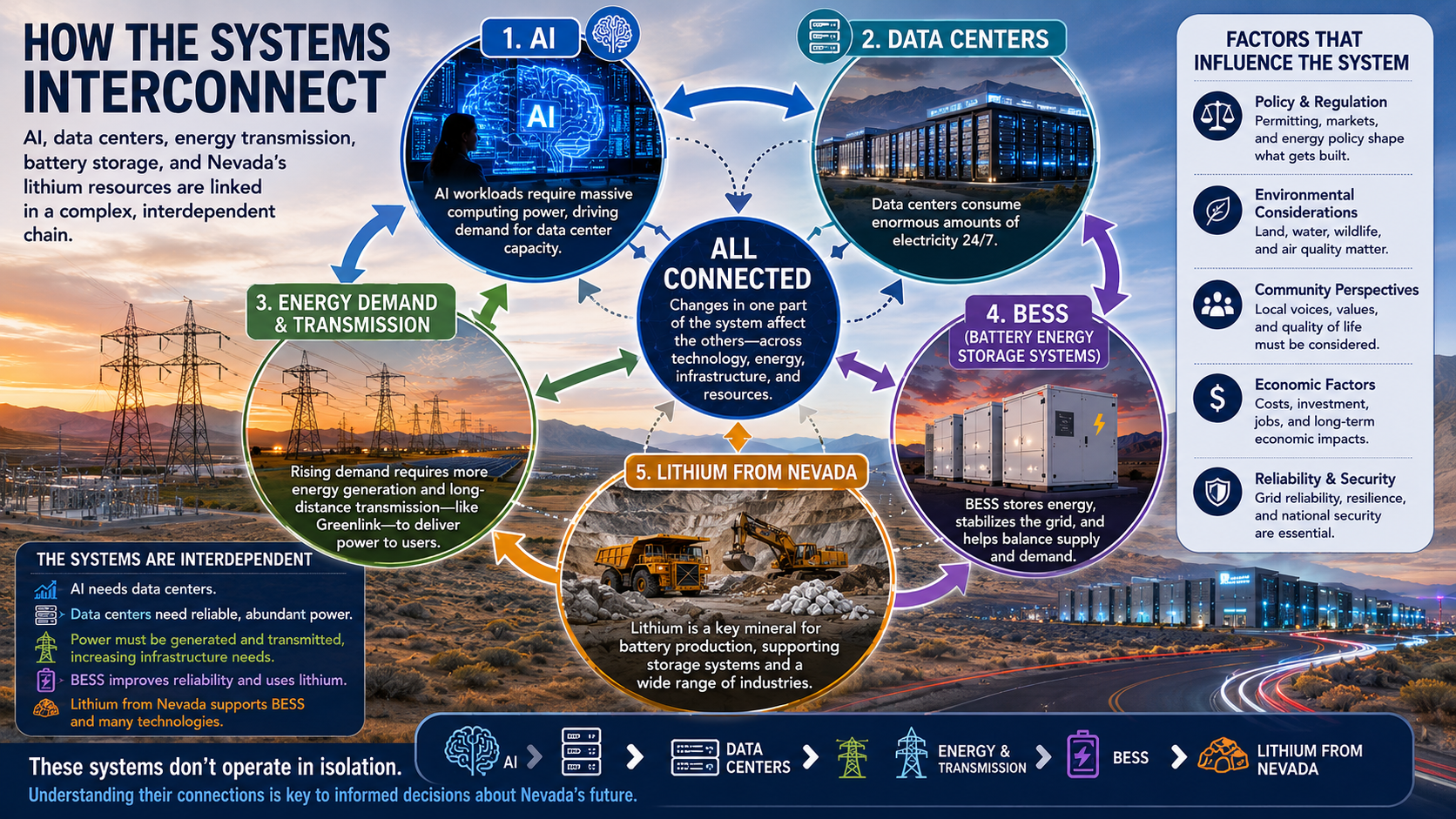
In viewing & interpreting this graphic, it is difficult to have the benefits of #1: AI, without the supports of #s 2,3,4,5. There are many challenges ahead!



More Stories
Yerington City Council Agenda, Zoom Link & Documentation for Monday, September 14, 2026
SLMC’s New Clinic is ‘Going Vertical’
A Story in Paint Told by Stephanie LaBranch: The New Mural at Yerington City Hall